

Khmer text to speech is the technology that turns written Khmer script into spoken audio, and in September 2026 it is far less mature than most business buyers assume. Open Google Cloud's Text-to-Speech console and Khmer is not on the list: the API that reads menus, contracts and support scripts aloud in more than 75 languages does not yet cover the language spoken by most of Cambodia's 17.9 million people (DataReportal, Digital 2026: Cambodia).
That gap changes how a Cambodian business should shop for Khmer voice AI. Below is what actually generates Khmer speech today, what it costs to run in a real product, and where we draw the line between a demo and a production build.
What is Khmer text to speech, and how accurate is it right now?
Khmer text to speech (TTS) is software that converts written Khmer script into spoken audio, and unlike English TTS it is still closer to a research project than a finished commercial product. The core technical obstacle is data: Khmer is a low-resource language for machine learning, meaning far fewer hours of transcribed speech exist to train a model compared with English, Thai or Vietnamese, which shows up directly in cost. Khmer text needs roughly 3.3 times more tokens than English to represent the same sentence in a large language model, a gap we measured directly in our AI development in Cambodia guide, and the same data scarcity that drives that token tax also limits how much Khmer speech audio exists to train a natural-sounding voice.
There is a second obstacle that has nothing to do with training data: Khmer script writes words with no spaces between them. Every engine runs a segmentation step before synthesis to work out where one word ends and the next begins, and that is exactly where mixed content breaks: a digit, a dollar sign or an English acronym embedded in an unspaced Khmer sentence gives the segmenter nothing to anchor on, so it mispronounces the fragment. Most generic Khmer TTS explainers skip this, because it only shows up once you test a real invoice line instead of a clean sample paragraph.
Cambodia is closing that gap from the inside as well as from outside vendors. The Institute of Digital Research and Innovation (IDRI), a Cambodian research institute, runs its own Khmer TTS project, building language-specific processing to handle Khmer's orthographic and grammatical structure rather than adapting a generic model (IDRI, Khmer TTS research page, 2026).
The earliest serious open dataset behind most of today's Khmer TTS work is SLR42, a high-quality Khmer speech corpus Google published for research in 2018 (OpenSLR, SLR42, 2018). Most of what has shipped since, commercial or open source, traces back to that same thin starting pool of recorded voices.
Does Google support Khmer text to speech?
No. Google Cloud's Text-to-Speech API, the default choice for most developers adding a voice feature to a product, does not list Khmer among its supported languages as of September 2026 (Google Cloud, Text-to-Speech supported voices and types). Teams that assume "if Google supports a language, it exists" run into this gap the moment they open the console and search for Khmer.
Microsoft's Azure AI Speech does support it. Two neural voices ship out of the box, km-KH-SreymomNeural (female) and km-KH-PisethNeural (male), alongside Khmer speech-to-text with fast transcription (Microsoft Learn, Azure AI Speech language support, checked September 2026). That makes Azure the only major hyperscale cloud with a documented, production-grade Khmer voice today. ElevenLabs, a well-known voice AI vendor, sits closer to Google than to Azure on this: its flagship Eleven v4 model advertises more than 90 languages for speech generation, but Khmer is not among them, even though the company offers a free Khmer speech-to-text tool on its site (ElevenLabs, supported models documentation, 2026).
We would not put a customer-facing Khmer voice agent into production on a free web demo tool. Production support needs a documented voice and a real service commitment, and today that means Azure's two neural voices or a self-hosted open model, not the consumer generators that currently rank on Google for this exact search.
Which platforms actually generate Khmer voice today?
Three categories currently generate Khmer voice, and mixing them up is the most common buying mistake we see: hyperscale cloud APIs, open-source models you host yourself, and consumer-facing web tools built around an undisclosed underlying engine. Most of what ranks in Google for a "khmer ai voice generator" search falls into that third, undersold category.
| Platform type | Example | Khmer voices | Best for | Watch out for |
|---|---|---|---|---|
| Cloud API | Microsoft Azure AI Speech | 2 neural (Sreymom, female; Piseth, male) | Production apps, IVR, AI agents | Limited voice choice, usage-based billing |
| Open source, self-hosted | Meta MMS (mms-tts-khm) | 1 base model you fine-tune | Sovereign hosting, no per-call fee | Needs ML engineering to deploy and tune |
| Consumer web tool | CAMB.AI and similar free-to-try voice generator sites | Several, engine usually undisclosed | Quick one-off voiceovers | No SLA, commercial licensing often unclear |
| Cloud API, no Khmer yet | Google Cloud, ElevenLabs | None for Khmer TTS (Sept 2026) | Not usable for this language today | The default most teams wrongly assume covers Khmer |
The Khmer speech-to-text side of that table is more developed than the text-to-speech side, which is the opposite of what most buyers expect. Community teams have fine-tuned OpenAI's Whisper for Khmer, released Wav2Vec2 XLS-R models at 300 million and 1 billion parameters, and trained a Khmer-specific version of Qwen3-ASR on roughly 700 hours of transcribed Khmer speech (GitHub, awesome-khmer-language, 2026). Nothing on the open source ai khmer voice side has that scale yet for generation, only for recognition.
Why Cambodian businesses are asking about Khmer voice AI now
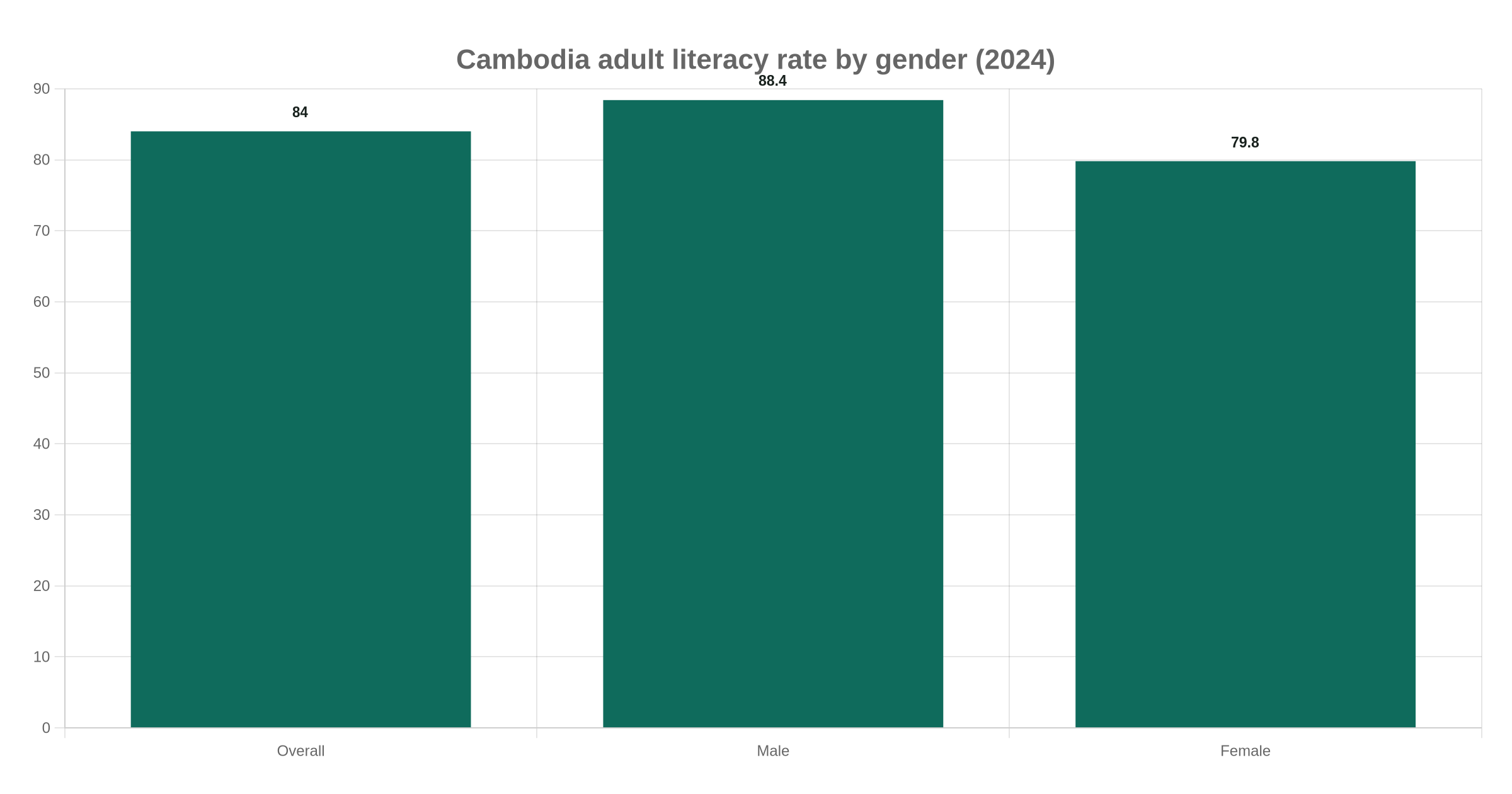
Search interest in "ai khmer voice" tools is rising in Cambodia for a demographic reason as much as a technology one: reading a long block of Khmer text on a small screen is not everyone's easiest channel. Cambodia's adult literacy rate stands at 84 percent overall, with a real gap between men (88.4 percent) and women (79.8 percent), the lowest overall figure in Southeast Asia (World Population Review, cited by Cambodianess, 2024).
Volume is the other driver. Cambodia's National Bank recorded 601.3 million KHQR payment transactions worth 75.8 billion USD in 2023 alone (National Bank of Cambodia Annual Report 2023, via fintechnews.sg). Take a telecom or utility provider fielding 300 to 500 Khmer-language support calls a day about billing and outages. Voicing a confirmation back is the smaller half of that problem: the harder, more valuable step is Khmer speech-to-text, transcribing every inbound call so billing disputes and outage reports route to separate queues before a human picks up. Built on a fine-tuned Khmer Whisper or Wav2Vec2 model, that triage step is a one to two week integration, and it pays off before the same company ever needs a voice that talks back.
How much does Khmer text to speech cost to run in production?
Khmer text to speech costs fall into three brackets, and the API line item is rarely the real cost. Free consumer tools cap what they will convert at once, commonly a few thousand characters per file, which is fine for a single voiceover and unworkable for a live product. Cloud APIs like Azure bill per character generated, scaling with usage but requiring real integration work. Self-hosted open models like Meta MMS carry no per-call fee at all, only infrastructure and the engineering time to deploy and fine-tune them.
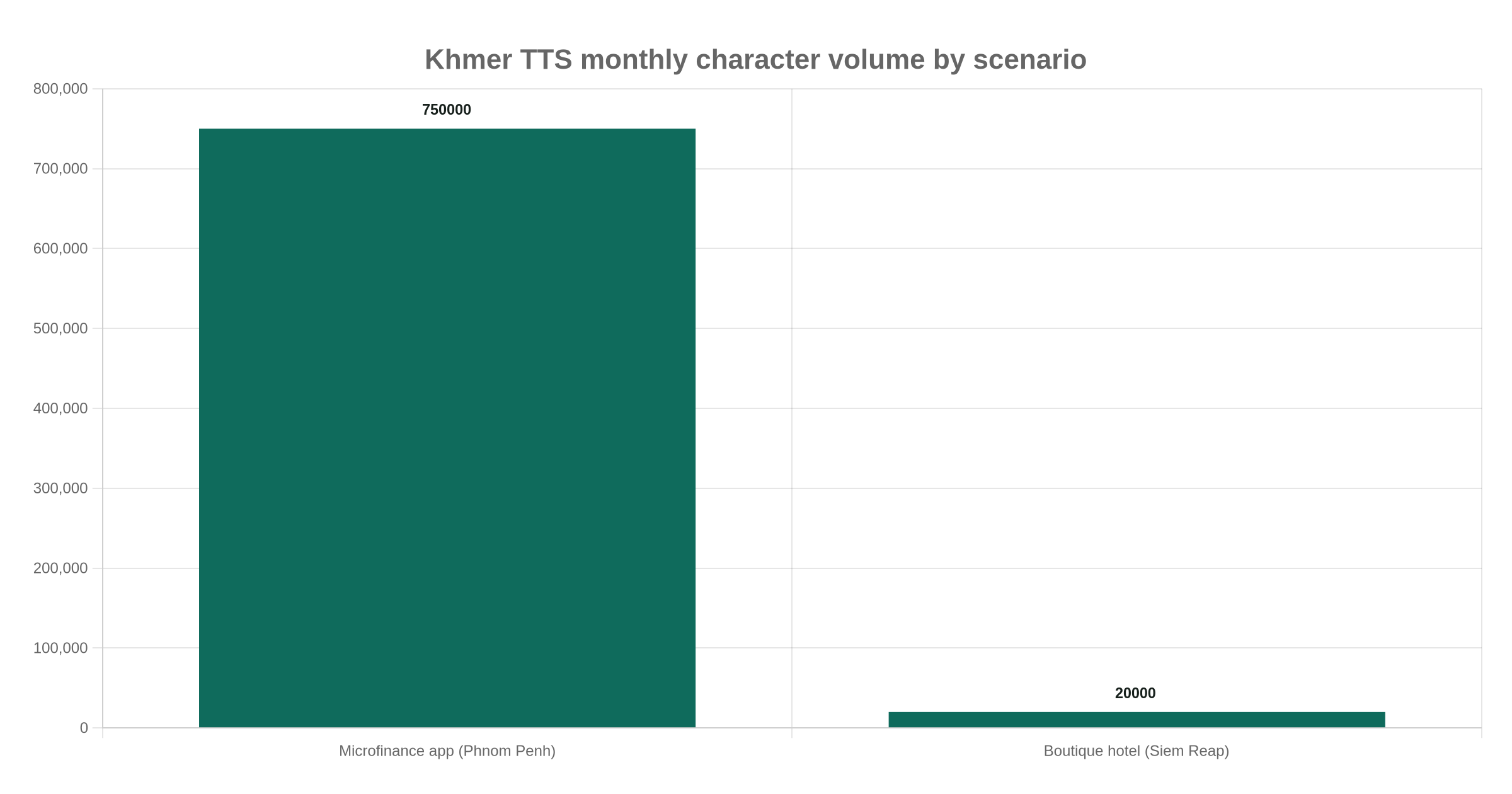
Take a realistic Cambodia scenario: a Phnom Penh microfinance app sending Khmer voice reminders for loan repayments to 5,000 customers a month, at roughly 150 Khmer characters per message. That is about 750,000 characters of generated audio a month, comfortably inside a cloud API's lower usage tiers. The real cost driver at that scale is not the per-character billing line, it is the developer time to template the Khmer text correctly, queue the requests, and cache the phrases that repeat every month instead of regenerating them.
Compare that to a much smaller operation: a 30-room boutique hotel in Siem Reap confirming bookings by phone in Khmer after a guest books through Telegram or Messenger. At around 200 bookings a month and 100 to 150 characters per confirmation, that is roughly 20,000 to 30,000 characters, a fraction of the microfinance app's volume and cheap enough that the API bill barely registers next to the integration work. What matters more at that scale is picking a vendor that will still support Khmer next year, not re-engineering the booking flow every time a free tool changes its terms.
What should you check before buying Khmer voice AI for your business?
Four checks catch most of the bad Khmer voice AI purchases that get referred to us after the fact:
- Test with real Khmer names, prices and abbreviations, not a clean sample paragraph. Consumer demo tools sound convincing on marketing copy and stumble on a mixed Khmer-and-number invoice line.
- Confirm commercial licensing in writing, not just a working free demo. A tool built for one-off YouTube voiceovers is rarely licensed for an always-on customer product.
- Ask where the audio and any submitted text are processed and stored. This matters directly once Cambodia's draft Law on Personal Data Protection is finalised, and it is a reasonable question to put to any vendor today.
- Decide whether speech-to-text or text-to-speech is the real priority, based on the workflow you are automating, not on which one is easier to demo. For most Cambodian SMEs, understanding Khmer speech matters more this year than generating it: get Khmer speech-to-text right inside a support workflow before promising customers a bot that talks back in natural Khmer.
How TechFlow builds Khmer voice into agents and workflows
As an AI agency in Phnom Penh, we treat a Khmer voice feature the same way we treat any other integration: it gets scoped, tested against real data, and connected through the same orchestration layer as the rest of a client's automation, not bolted on separately. Our AI agents and automation work runs on n8n and OpenRouter, calling models from Claude, GPT, Mistral or Llama depending on the task, deployed on a private cloud or sovereign server so a client controls exactly where Khmer customer data lives.
The process starts the same way for a voice feature as for any other automation: a free 1 to 2 hour process-mapping audit, a costed action plan within 5 days, deployment in 1 to 4 weeks, then monthly improvement reports. If you already know which workflow needs a Khmer voice, whether that is inbound support, payment confirmations or an internal tool, our AI consulting process ranks it against your other automation candidates before we build anything. Once a workflow is confirmed, our guide to agent running costs sets expectations on the ongoing budget.
Talk to our AI agents team or request a scoped estimate if a Khmer voice feature is on your roadmap for 2026.
Prefer to chat? Message our founder directly on Telegram (@maxgrolier), or book a call with the team.
Frequently asked questions
Is Khmer text to speech accurate enough for customer-facing use?
It depends on the vendor and the content. Azure's neural Khmer voices and well-tuned open models handle clean Khmer sentences reliably; accuracy drops on mixed Khmer-and-number content like prices, dates and account numbers, so that content needs testing before launch, not after.
What is the difference between Khmer speech-to-text and text-to-speech?
Speech-to-text (ASR) transcribes spoken Khmer into written text, useful for understanding customer calls or voice messages, while text-to-speech (TTS) converts written Khmer into spoken audio, useful for reading confirmations or scripts aloud. The Khmer ASR ecosystem is currently more developed than the Khmer TTS one.
Can I self-host a Khmer voice model instead of using a cloud API?
Yes. Meta's MMS project publishes an open Khmer TTS model (mms-tts-khm) that a technical team can self-host, avoiding per-call fees at the cost of infrastructure and machine learning engineering time to deploy and tune it.
Does Khmer text to speech work well with mixed Khmer and English text?
Not reliably by default. Khmer has no spaces between words, so an English brand name, acronym or number dropped into a Khmer sentence gives the engine's segmentation step nothing to anchor on, and it often mispronounces the fragment. This needs a specific test pass with real mixed-language content before a script goes live, not a clean single-language sample.
How long does it take to add Khmer voice to an existing chatbot or IVR?
For a scoped integration into an existing workflow, expect 1 to 4 weeks once the vendor and script are chosen, matching the deployment timeline for any other AI agent build. The audit and action plan phase before that typically adds another 5 to 7 days.
Is there a free way to test Khmer text to speech before committing budget?
Yes. Azure's Speech Studio offers a free tier for testing its two Khmer neural voices, and Meta's MMS Khmer model can be tested through a public Hugging Face demo space before any infrastructure decision is made.